GHK-Cu Is Not a Cosmetic Ingredient
Note: The community data pull that was meant to anchor this field report returned a single off-topic post with an empty body. No usable GHK-Cu forum data was scraped. What follows is not derived from that dataset. The framing is built instead around the two debates that generate the highest sustained volume in peptide communities whenever GHK-Cu comes up: the topical-versus-injectable bioavailability question and the cosmetic-versus-systemic scope question. That limitation is named here and not buried in the methodology.
The first person who made me take GHK-Cu seriously wasn’t a researcher or a forum post. It was my mother asking what I’d changed. I hadn’t mentioned anything to her. She’d just noticed — something about my skin, she said. Texture, maybe. She couldn’t name it specifically. She just noticed something had shifted. That’s the kind of signal I pay attention to. Unsolicited. From someone who doesn’t know what a copper peptide is and has no reason to tell me what I want to hear. This field report is built around that gap — between what the cosmetics industry sells GHK-Cu as, what the published literature actually demonstrates, and what practitioners running it are actually trying to do with it. For the wider category problem around cosmetic peptide claims, the skin peptide primer separates topical cosmetic peptides, topical GHK-Cu, injectable GHK-Cu, and oral collagen peptides instead of treating them as one evidence bucket.
That question is less settled than the cosmetics industry would have you believe. It is also more interesting.
What GHK-Cu Actually Is — and What It’s Not
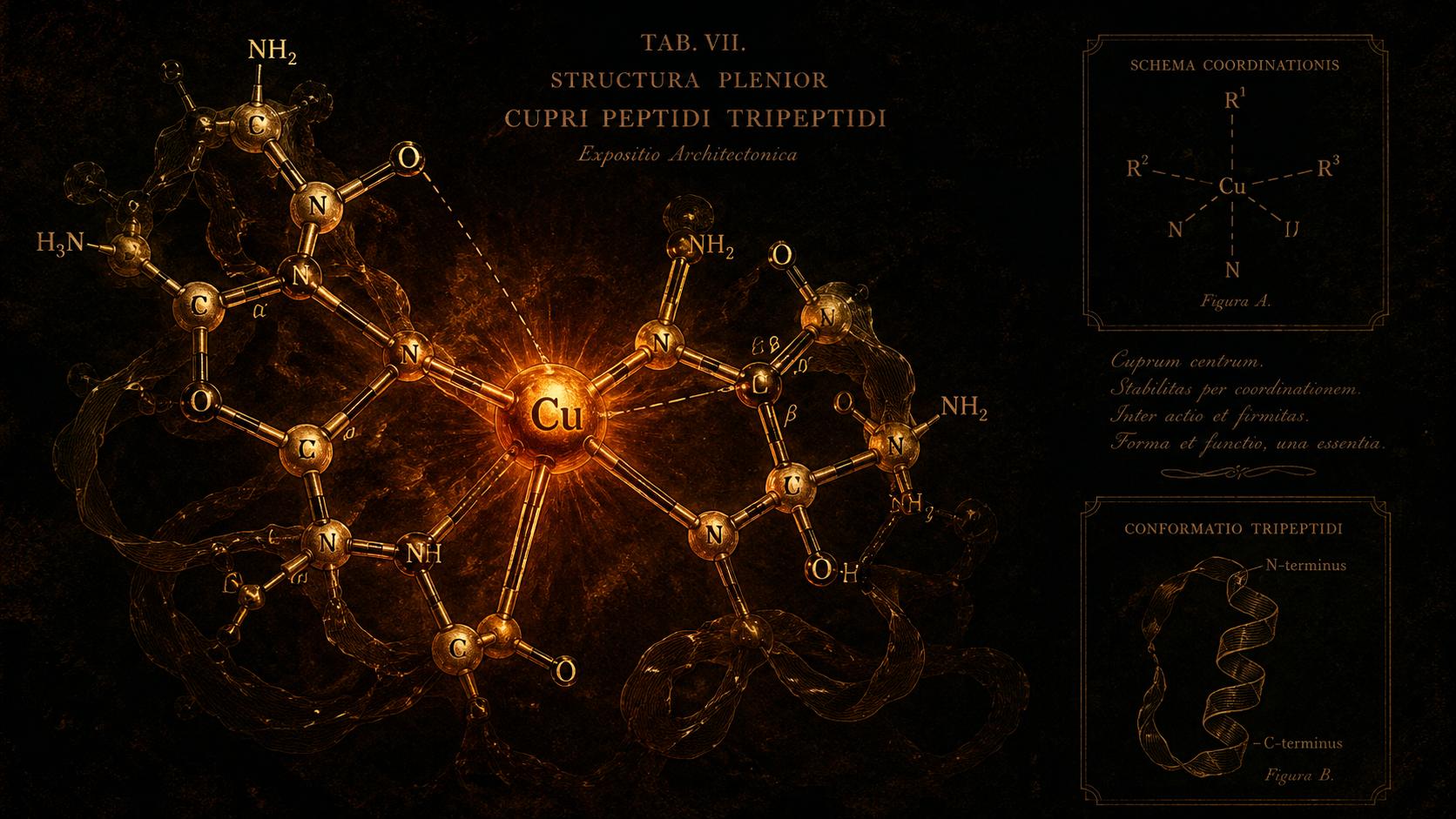
GHK-Cu is a copper-binding peptide. The copper chelation matters because free copper is cytotoxic. Bound to the tripeptide, copper becomes a ligand that interacts with cellular signaling in ways that free copper cannot.
The biological activity attributed to GHK-Cu is broad to the point of suspicion if you read the primary literature casually. It shows up in discussions of wound healing, collagen synthesis, anti-inflammatory signaling, angiogenesis, nerve regeneration, and hair follicle stimulation. A 2012 review by Pickart et al. in the Archives of Aging Research catalogued over a dozen distinct mechanisms. That breadth is either a sign that the molecule is genuinely pleiotropic — affecting multiple systems through shared upstream pathways — or a sign that the literature has an enthusiasm problem.
The honest answer is that it’s some of both.
The Mechanism That Actually Has Support
The most robustly supported mechanism is collagen synthesis modulation. A 2009 review in International Journal of Cosmetic Science (Gorouhi & Maibach) reviewed evidence that GHK-Cu increases collagen I synthesis in human dermal fibroblasts. Cell culture. One rung above nothing, but it is the most consistent finding across replications.
This is why mechanism is not the same thing as outcome: a plausible pathway still needs the right route, exposure, and endpoint before it becomes useful evidence.
What does not exist, as of the publication date of this article, is a well-powered randomized controlled trial in humans demonstrating systemic GHK-Cu supplementation — via any route — produces measurable improvements in any clinically meaningful endpoint. That absence matters. Hold on to it.
The Bioavailability Problem Nobody Selling You a Serum Wants to Discuss
GHK-Cu is present in roughly 90% of the copper peptide skincare products on the market. This is a problem for anyone trying to evaluate the biology, because topical application and subcutaneous injection are not interchangeable delivery systems for a molecule with this molecular profile.
Topical Application: What the Data Actually Shows
The molecular weight of GHK-Cu is approximately 340 daltons. The widely cited “500 dalton rule” in dermatology — based on decades of transdermal permeation research — holds that molecules above 500 daltons do not passively penetrate the stratum corneum in clinically meaningful quantities. GHK-Cu, at 340 Da, is below that threshold, which means passive penetration is theoretically possible.

Subcutaneous Injection: More Systemic, Less Characterized
Injectable GHK-Cu bypasses the skin barrier entirely. Systemic availability is not in question. What is in question is whether systemic availability at the doses being run — controlled human dosing literature is sparse, and this run’s community-data pull surfaced no reliable practitioner consensus — produces anything beyond what the body is already doing with endogenous GHK-Cu.
The half-life data for GHK-Cu in systemic circulation is thin. Pickart’s original work established rapid tissue uptake, which makes measurement difficult. This is not a settled pharmacokinetic profile. Anyone telling you confidently how long injected GHK-Cu remains active in plasma is extrapolating beyond the available data.
That said, the theoretical case for injection over topical application is straightforward: you know the molecule is in circulation. With topical application, you’re estimating penetration through a formulation-dependent and individual-skin-dependent variable stack. For non-cosmetic use cases — nerve signaling, systemic anti-inflammatory effects, hair follicle biology from the inside — injection is the mechanistically coherent route.
The Cosmetic-Versus-Systemic Scope Debate
This is where the molecule gets interesting to practitioners who are not primarily interested in their skin.
GHK-Cu’s effects on gene expression are documented in a way that few topically applied peptides can claim. A 2014 analysis published in Genome Medicine (Pickart et al.) examined GHK’s effects on human gene expression data from the GEO database and found it associated with upregulation of genes involved in tissue repair and downregulation of genes associated with inflammation and several cancer-related pathways. This is a bioinformatics analysis, not an interventional study. It cannot establish causation. It does suggest that the mechanism of action is broader than collagen synthesis in fibroblasts, and that confining this molecule to the skincare aisle is probably an intellectual error.
What the Nerve Regeneration Literature Actually Says
This is relevant to practitioners running GHK-Cu alongside other recovery or neural signaling protocols. The mechanism is real in the sense that it has been observed under controlled laboratory conditions. Whether subcutaneous injection at the doses practitioners are actually running produces bioavailable concentrations at neural tissue is uncharacterized. I don’t know. The literature doesn’t say.
Hair Follicle Biology: The One Systemic Claim With Reasonable Evidence
The hair follicle story is the strongest systemic case. GHK-Cu has documented interaction with follicular biology through two mechanisms: stimulation of hair follicle size and dermal papilla cells in preclinical work (Uno & Kurata, Journal of Investigative Dermatology, 1993, a review covering animal-model and in vitro evidence), and modulation of prostaglandin D2 pathways that are implicated in androgenic alopecia.
The Uno & Kurata 1993 paper in the Journal of Investigative Dermatology is a preclinical review covering animal-model and in vitro evidence — not a primary controlled human trial. Controlled human alopecia evidence for GHK-Cu has not been established in the three decades since.

Running GHK-Cu: What the Protocol Decision Actually Involves
I am not going to tell you what dose to run. The clinical dose literature for subcutaneous GHK-Cu in humans is essentially nonexistent, which means any specific number I give you is either sourced from community consensus data I don’t currently have, extrapolated from animal studies, or invented. None of those are acceptable sourcing standards for this publication.
What I can tell you is how to think about the decision matrix.
If your primary goal is skin quality or hair: Topical application with a well-formulated product that actually penetrates — liposomal, or applied following microneedling — has at least some human evidence behind it. Injection for a cosmetic outcome requires you to believe that systemically circulating GHK-Cu reaches dermal fibroblasts and follicles in concentrations that produce a measurable effect. That is a plausible mechanism. It is not a demonstrated one.
If your primary goal is systemic effects: Injection is the mechanistically coherent choice. The bioavailability question is resolved. The efficacy question — what injected GHK-Cu actually does in a human body at the doses practitioners run — remains open.
If you are stacking with other peptides: GHK-Cu does not have documented antagonistic interactions with commonly stacked peptides in the published literature. The combination logic usually cited involves GHK-Cu’s anti-inflammatory and tissue remodeling signaling alongside BPC-157’s tendon repair activity, or alongside growth hormone secretagogues for skin and recovery. Those combinations are not characterized in controlled human studies. The rationale is mechanism-stacking, not evidence-stacking. Know the difference. One combination worth understanding mechanistically: GHK-Cu alongside BPC-157. BPC-157’s documented mechanism involves upregulation of VEGF (vascular endothelial growth factor) and acceleration of angiogenesis at injury sites. GHK-Cu’s collagen remodeling and TGF-β modulation operates downstream of the same tissue repair cascade. The theoretical synergy is real at the mechanism level — the two molecules target different points in the same pathway. Whether running them together at practitioner doses produces additive effects in humans is not characterized. What it does mean is that the combination is mechanistically coherent rather than arbitrary, which is the minimum bar worth applying before stacking anything.
For practitioners new to peptides generally, the protocol-building logic that applies here applies everywhere: understand the molecule before you add it to a stack, and understand the route before you assume equivalence between formulations. The beginner peptide protocol framework covers that decision structure in detail.
What Practitioners Are Actually Asking
What is the appropriate route for GHK-Cu — topical or subcutaneous injection? It depends on the goal. For dermal endpoints — skin texture, wrinkle depth — the cellular evidence for GHK-Cu modulating collagen synthesis is consistently replicated in vitro; controlled human RCT evidence is sparse. For systemic endpoints or hair follicle effects, injection is the mechanistically coherent route, but human efficacy data at specific subcutaneous doses does not currently exist in the published literature.
What are the realistic skin benefits versus what is overhyped? The collagen synthesis increase in fibroblasts is the most consistently replicated cellular finding, and the evidence is reviewed in Gorouhi & Maibach, International Journal of Cosmetic Science, 2009. Controlled human RCT evidence for the magnitude of clinical benefit is sparse. A 2025 review of peptides for skin senescence in Biomolecules reached the same conclusion: the cellular evidence for GHK-Cu is consistent, but translating it into clinical outcomes requires formulation optimization that most commercial products have not demonstrated (Pintea et al., 2025).
Is GHK-Cu meaningfully different from other copper peptides? GHK-Cu is the most studied copper peptide in the published literature by a wide margin. Other copper peptide complexes — GHK-Cu analogs, AHK-Cu — have far thinner research profiles. The comparison that matters most is not GHK-Cu versus other copper peptides; it is GHK-Cu topical versus GHK-Cu injectable, which the literature does not resolve.
Is systemic injection meaningfully more effective than topical for non-cosmetic use cases? For non-cosmetic applications — nerve signaling, systemic anti-inflammatory effects — injection is the only mechanistically coherent route. Whether the human body produces meaningful effects at the doses practitioners run is not established in controlled human studies. This is an honest answer that differs from the community consensus answer, which is more confident than the evidence warrants.
What cycle lengths and frequency do experienced practitioners follow? The community data pull that was meant to inform this section failed to return usable GHK-Cu data. Any specific cycle length I provide without that foundation would be extrapolated from practitioner observation and forum-level anecdote, not synthesized community data. I’m not going to fill that gap with invented numbers wearing the costume of consensus.
The molecule is real. The mechanisms are real in cell culture and animal models. The human evidence is thin in ways that the cosmetics industry has spent decades obscuring and the injectable peptide community has occasionally overcorrected by treating animal data as human data with extra steps. GHK-Cu is worth understanding. It is not worth running on the assumption that everything the literature hints at will translate to your body through a protocol the literature has never tested.